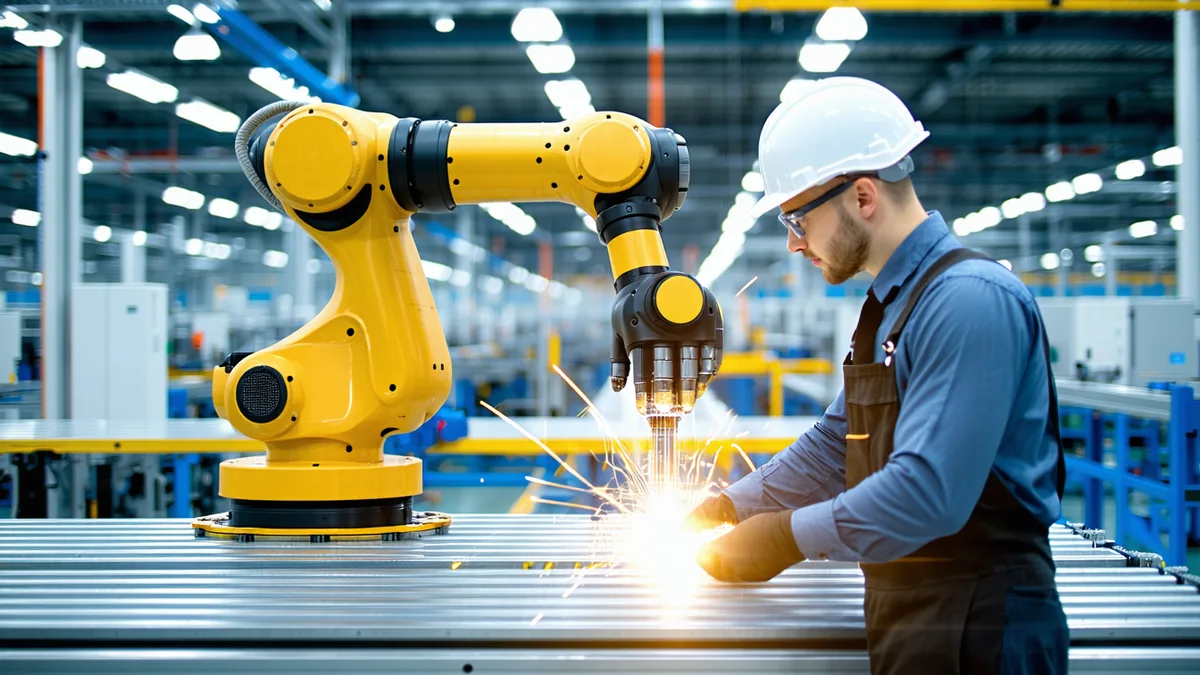
The assembly line is not a blank slate. When a new robot is introduced into an existing factory floor, the workers who have been on that line for three to fifteen years have developed a dense set of micro-habits: where they place finished sub-assemblies so the next operator downstream can pick them up efficiently, which direction they reach without looking, when they take a half-step backward to give someone else clearance, how they position their bodies to absorb the ergonomic impact of repetitive motions. Most of this knowledge is tacit and none of it is in the process documentation.
A robot that is mechanically safe but procedurally disruptive will not produce a good outcome. The ISO 10218 and ISO/TS 15066 compliance machinery handles the force-and-speed envelope. The design work that determines whether the robot actually improves the line versus fractures it is different work, sitting at the intersection of process engineering, ergonomics, and control system architecture.
Spatial Assignment Before Kinematic Assignment
The first design decision in human-robot coexistence is not what the robot will do — it is where it will stand and what physical territory it owns. This sounds obvious and is frequently skipped in the rush to define the robot's task list.
The rule from industrial ergonomics practice: a worker and a robot sharing a station should have non-overlapping primary reach envelopes during normal operation. The overlap zone — the space that both could reach simultaneously — should be defined explicitly, bounded physically if possible (a parts fixture that creates a natural boundary between the human's primary workspace and the robot's primary workspace), and treated as a sequenced access zone if physical separation is not possible. One entity is in the overlap zone at a time, and both entities know it.
This seems to reduce robot utilisation, and it does in one narrow sense. But the alternative — a shared zone where the robot and human are simultaneously active — creates cognitive load on the human worker that manifests as fatigue, hesitation, and error, even when no physical collision occurs. Workers sharing a station with a robot that moves unpredictably into their reach zone report elevated stress even when the robot's physical safety systems are fully functional. That stress has a throughput cost that is worse than the reduced utilisation of a well-bounded layout.
Motion Predictability as an Ergonomic Variable
Human workers unconsciously read the motion patterns of everything in their environment — other workers, material handling equipment, machinery. They use this reading to anticipate where things will be half a second from now and adjust their own movements accordingly. This anticipatory behaviour is metabolically cheap and fast; it happens below conscious awareness. When an element of the environment is unpredictable, the anticipatory system has to fall back to slower, conscious monitoring, which is both cognitively expensive and slower to react.
A humanoid robot working alongside humans should move predictably in two senses. First, its trajectories should be geometrically consistent: it should reach for the same fixture position the same way each cycle, so that a worker next to it can develop a model of where its arm will be at any given moment in the cycle. Second, its transitions between tasks should be clearly signalled: if the robot is about to change from placing parts in the output bin to reaching for the next sub-assembly, that transition should either be preceded by a momentary neutral pose or indicated by a directional cue (arm pulling back to centre before extending in a new direction) that gives the co-worker time to adjust.
We are not saying that a humanoid robot's motion needs to be telegraphed so slowly that it degrades cycle time. We are saying that there is a meaningful design distinction between motion profiles optimised purely for speed and motion profiles optimised for the combination of speed and human readability — and that getting the latter right is both possible and necessary for co-working applications to function as intended.
Handoff Design: The Critical Interface
The moment in a human-robot collaborative task where most disruption originates is not during concurrent parallel operation — it is at the handoff point, where something moves from the robot's responsibility to the human's or vice versa.
Consider a scenario on a small-appliance assembly line in the Kanto region: the robot picks a motor housing from a tote, seats it in a fixture, and the human worker then installs the motor drive board. The robot's place action needs to produce a housing position and orientation that is consistently within the worker's comfortable reach envelope, at a height that doesn't require stooping or overstretching, with the mounting holes in the correct orientation for the worker's next move. If the robot seats the housing two centimetres off the nominal position on 5% of cycles — well within the fixture's tolerance, so the robot never errors — the worker has to visually re-check and micro-adjust on those cycles, adding roughly 1.5–2 seconds and breaking the motion routine they have built up. Over a full shift this is a significant fatigue and throughput cost.
Handoff position consistency — tighter than the mechanical tolerance the task actually requires — is therefore a specification that comes from the ergonomics of the downstream human task, not from the upstream mechanical requirements. This distinction matters for how you spec the robot's position accuracy, and it is a design input that will not appear in standard fixture drawings.
Floor Marking, Lighting, and Status Communication
Collaborative robot deployments in factory environments consistently benefit from explicit environmental communication layers that go beyond the robot's own status indicators. Workers who spend eight hours on a line develop fast, peripheral-vision-based situational awareness; they are not looking directly at the robot's status LED during operation.
Floor zone marking — coloured tape or embedded LED strips indicating the robot's operating zone, with a colour convention workers can read without stopping their task — has a measurable effect on approach caution and error rates near robot stations. Overhead status lighting visible from multiple angles in the robot's operating area (green: normal operation, amber: reduced-speed mode, red: stopped/fault) follows the same peripheral-readability principle. These are low-capital additions that reduce the cognitive load on workers who need to maintain situational awareness of multiple elements simultaneously.
Robot posture design also contributes here. A humanoid robot in its "waiting" state should adopt a neutral pose that reads clearly as non-operational — arms at rest, no micro-adjustments or head tracking — rather than a pose that could be interpreted as pre-motion preparation. Workers are sensitive to these posture cues and will unconsciously increase their clearance buffer if the robot appears to be "about to do something." Designing the idle pose for passive readability is a detail that costs nothing in hardware and pays off in worker confidence.
Iteration Requires Data
The layout and motion profile decisions made before a robot is deployed on a line will need revision once it is running. The ergonomic effects of specific motion patterns, handoff positions, and idle poses only become visible in the context of actual production, with actual workers who have their own height, reach, and movement patterns. First deployments should be treated as parameterised installations rather than final configurations: key design variables should be instrumented, worker feedback should be collected systematically in the first weeks, and a defined review point at 30–45 days should be built into the deployment plan.
This is normal practice for any significant line change. What is different for humanoid robots is that the adjustment space is larger: motion trajectory parameters, approach angles, handoff position offsets, and cycle pacing are all adjustable after deployment in ways that fixed-arm installations typically are not. That adjustability is an advantage if you plan to use it.