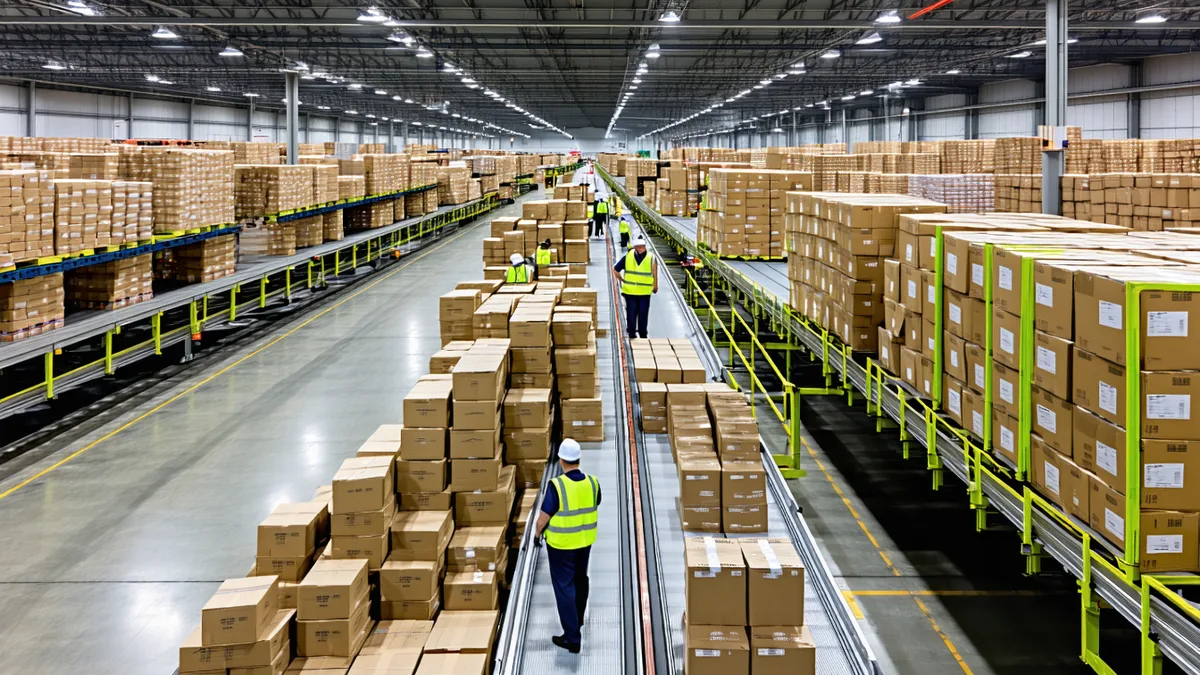
The robotics industry's attention has concentrated on warehouse interiors: autonomous mobile robots navigating rack aisles, conveyor-integrated pick stations, AS/RS systems pulling pallets from high-bay storage. The investment case for indoor warehouse automation is clear, the environment is structured, and the major vendors have years of deployment data. The technology is relatively mature.
The logistics yard — the outdoor and semi-covered space where trucks dock, freight transfers between carriers, and cargo is sorted for onward routing — is harder to automate and receives proportionally less engineering attention. It is also, for Japan's logistics operators specifically, where the labour shortage has become most acute and where conventional fixed automation fits worst. This article makes the case for why logistics yards are the more compelling near-term deployment opportunity for humanoid robots, and what the specific task requirements look like.
Why Yards Are Harder to Staff Than Warehouses
Warehouse interior labour shortages are real but partially offset by the fact that indoor warehouse work, with its relatively stable environment and clear sightlines, can be made physically manageable with adequate material handling equipment. Experienced workers develop efficient routines, and the indoor environment is controllable — temperature, floor condition, lighting.
Logistics yard work is different in character. It involves truck trailer unloading, cross-dock transfers between vehicles, freight sorting under time pressure dictated by departure windows, heavy manual handling of mixed cargo types that may include palletised freight, loose cartons, bagged goods, and irregular industrial equipment. The work is often performed in partial weather exposure. Shift start times cluster in the early morning (3–5am) to meet outbound departure windows. Physical demands — repetitive heavy lifting at awkward heights, carrying across uneven surfaces — drive injury rates and turnover that compound the staffing problem.
In practical terms: a growing-size regional logistics operator handling freight redistribution for three prefectures may process 800–1,200 inbound shipments per night across a dock with twelve truck bays. Each bay requires workers to unload the arriving truck, sort freight by onward destination, and stage it for loading onto outbound vehicles. The sorting step alone involves recognising package type, reading consignment labels, and placing packages in the correct staging zone — a task that requires enough cognitive engagement that it cannot be performed well by workers who are exhausted or inattentive. The combination of physical demand, shift timing, and cognitive requirement makes yard labour particularly hard to staff and hard to retain.
Where Fixed Automation Fails in Yards
Fixed conveyor systems work in yards where freight flows in well-defined, consistent streams. A logistics facility handling only uniform pallet-sized loads of a single product category — a beer distributor's cross-dock, for example — can automate much of the flow with fixed conveyors and pallet jacks. That is a narrow set of real-world operations.
Most logistics yards handle mixed freight: a truck arrives with forty consignments of varying sizes, weights, packaging types, and destinations. The consignments are not necessarily loaded in a way that makes unloading in destination order convenient. Some are fragile, some are ambient, some require refrigerated staging. A fixed conveyor system serving this kind of operation needs to be general enough to handle the variance, robust enough to handle the physical conditions, and flexible enough to reconfigure as freight volume and destination patterns shift with the business. Building that system is expensive, requires significant civil work to install, and still does not handle the exception cases — the consignment that has shifted and jammed against the door, the pallet that has partially collapsed, the oversized item that does not fit the conveyor geometry.
This is the operational gap that humanoid robots address directly. Not by replacing the entire materials handling operation, but by taking on the specific tasks — unloading mixed freight from truck trailers, sorting by destination zone, exception handling for items outside normal parameters — that require human-shaped physical capability and judgement in the face of variance.
The Specific Task Set for Yard Deployment
A practical humanoid deployment in a logistics yard targets three task categories.
The first is trailer unloading. A truck trailer loaded at origin contains freight that may be stacked in any configuration that fit. Unloading requires: assessing the configuration, determining safe unloading sequence, extracting individual consignments (which may weigh anywhere from 2–30kg for typical parcel freight), and placing them on a staging conveyor or pallet. The reach into the trailer, the varied weight handling, and the spatial judgement required to extract items from a packed configuration without destabilising the remaining load are well-matched to humanoid capability — and are exactly the tasks that cannot be addressed with fixed automation without converting every truck to a standardised loading configuration, which is operationally impractical.
The second is destination sorting. Once consignments are on the dock, they need to be identified and directed to the correct staging zone. This combines vision — reading package labels, recognising package type — with locomotion and manipulation to carry the package to the right location. The spatial awareness and navigation requirements are within the operational envelope of current humanoid locomotion systems for a well-structured dock environment.
The third is exception handling: packages that have fallen off conveyors, freight that has arrived damaged or outside normal dimensions, trucks that have arrived out of sequence. Human workers spend a disproportionate fraction of their cognitive effort on these exceptions, because the cost of mishandling an exception is higher than the cost of mishandling routine freight. A humanoid with adequate perception can take on at least the physical component of exception response — retrieving fallen items, repositioning freight — leaving humans to make the judgement calls on damaged goods or routing decisions.
Environmental Challenges in Yard Deployment
Logistics yards present environmental conditions that are harder than factory interior deployments. Temperature variation across seasons in Honshu spans roughly -5°C to +38°C in exposed dock areas. Flooring is often uneven — asphalt with patching, dock leveller plates, ramp transitions between dock height and yard level. Lighting conditions vary from artificial dock lighting at night to direct sunlight during daytime operations. All of these are within the operating envelope of a well-engineered humanoid, but they add requirements that need to be specified clearly: IP rating for humidity and rain exposure in semi-covered dock areas, thermal management for the battery and compute stack in temperature extremes, locomotion stability on surfaces that are not the clean epoxy floor of an indoor factory.
We are not saying that logistics yard deployment is straightforward. The environmental demands are real, and the first generation of deployments will need careful environment characterisation before a robot goes into full operation. What we are saying is that the yard environment, despite being more variable than a factory interior, is more variable in ways that are predictable and engineerable — not in ways that are fundamentally beyond current system capability. The harder problem is not the environment; it is the task variance in the freight itself.
The Staffing Math for Logistics Operators
For a logistics operations director evaluating the humanoid robot case, the relevant calculation is not robot cost versus one worker's wage. It is robot cost versus the fully-loaded cost of filling the position: recruitment, training, overtime premium for night shifts, turnover cost when the worker leaves (which, for logistics yard labour in Japan, can be within 6–12 months), and the throughput cost of running understaffed. Industry estimates for the total cost of a filled logistics labour position in Japan's major distribution regions, including all turnover and overtime factors, run significantly above the nominal annual salary figure. Against that calculation, and particularly against the scenario where the position is genuinely unfillable rather than merely expensive to fill, the economics of a humanoid robot deployment look different than a simple wage comparison suggests.
The first deployments at logistics yards will be targeted — specific task categories, specific dock configurations, well-characterised freight types. They will not replace the workforce. They will fill the positions that are hardest to staff, reduce the physical load on the workers who remain, and generate the operational data needed to expand scope. That is how new automation always enters industrial operations, and there is no reason to expect humanoid robots to be different.