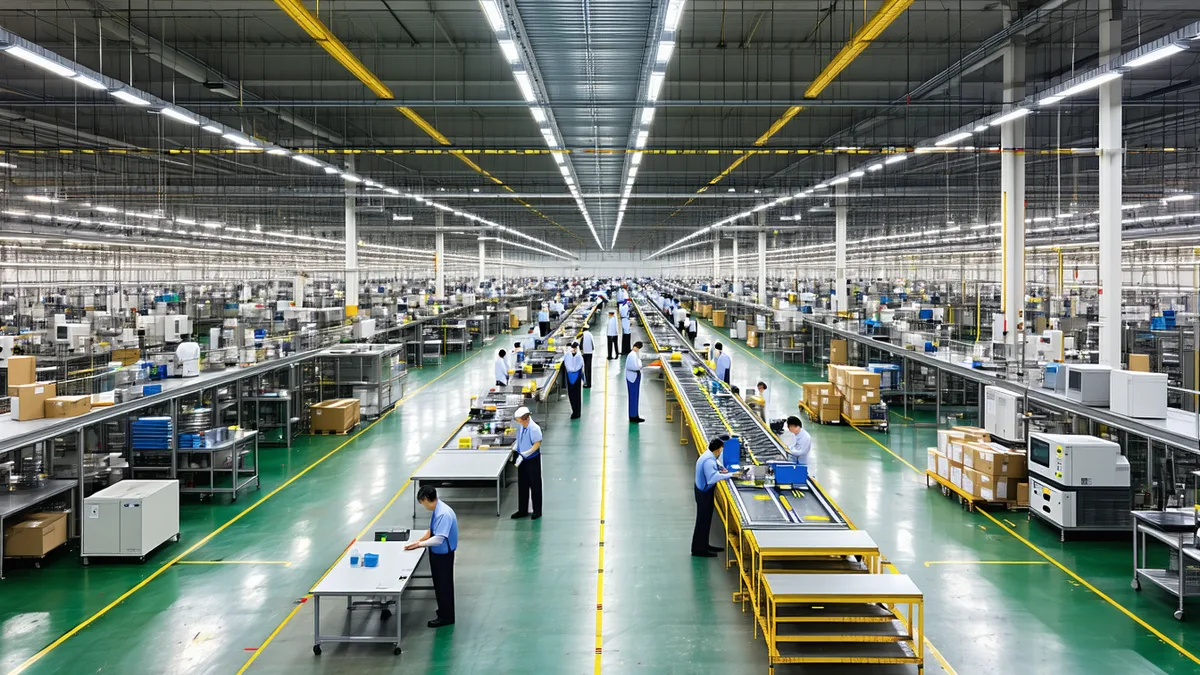
Japan's manufacturing sector has run on labour surplus for decades. The floor supervisors who remember the 1980s bubble era will tell you that the headcount was there, the wages were manageable, and the biggest challenge was keeping people from leaving for Tokyo's service economy. Today the challenge is reversed. METI surveys consistently show that manufacturers in the Chubu and Kyushu regions — automotive supply chains, electronics sub-assembly, precision parts — are reporting vacancy rates across manual-handling roles that they cannot fill at any competitive wage. The demographic arithmetic is not in their favour, and it does not improve.
The instinct of most plant managers is to reach for what they know: more fixed automation. Another articulated arm on the stamping line, another vision-guided conveyor sort, another gantry over the palletising station. Fixed automation is excellent when it works. For high-volume, low-mix production with stable part geometries, a well-spec'd robot cell can outperform a team of twenty for fifteen years straight. The problem is that a growing share of factory work is not like that.
The 30% Geometry Problem
The rule of thumb in industrial robotics integration circles is that roughly 60–70% of the tasks in a typical mixed-mode manufacturing facility are accessible to conventional fixed automation given sufficient capital spend. The remaining 30–40% involve either irregular object geometry, non-standard grasp orientations, multi-step sequences requiring judgement calls, or close proximity to human workers doing concurrent tasks — conditions that fixed-arm systems handle badly or not at all without site-specific engineering that rivals the cost of the line itself.
A concrete example from automotive sub-assembly: inserting a wiring harness into a door panel requires reaching around the panel edge, routing the harness through three clips at slightly different angles on each panel variant, then pressing a locking tab until it clicks. None of the individual motions exceeds the force or reach envelope of a standard 6-axis arm. But the variance — different clip positions across model years, harness slack variation, panels arriving at slightly different orientations — means that making a fixed arm reliable on this task requires tooling investment that often exceeds the cost of keeping the human worker. The maths has never made sense. So the task stays manual, and when the manual workforce shrinks, throughput falls.
Why the Humanoid Form Factor Is Not Coincidence
The humanoid form — two arms, two legs, head-mounted sensors, roughly human reach and height — emerged because the physical environment of the factory was built for human bodies. The workbench height, the aisle width, the overhead clearance, the distance between stations, the grip diameter of most tooling: all of these dimensions were set with a 50th-percentile human in mind. A robot that shares that form factor inherits all of that compatibility for free.
This is not a trivial point. Deploying a fixed robot arm into an existing factory line requires significant infrastructure change: modified mounting, safety guarding, reconfigured part flow, sometimes structural reinforcement. The installation cost frequently exceeds the hardware cost. A humanoid that can walk to the station, stand at the bench, and use the existing tooling fixture sidesteps much of that overhead. The deployment friction is closer to onboarding a new worker than to installing a machine.
We are not saying that humanoids will replace fixed automation for the high-volume, high-repeatability tasks where fixed automation already excels. A humanoid running a stamping press at 600 strokes per minute makes no sense. The value proposition is specific: the irregular, variable, multi-step, human-proximate tasks that have resisted automation for decades precisely because they required a human-shaped body moving through a human-shaped environment.
Japan's Specific Labour Geography
The labour shortage in Japanese manufacturing is not evenly distributed. It concentrates in three patterns that humanoid robotics is unusually well-positioned to address.
The first is geographic. Rural prefectures — Aichi's outer rings, Iwate, Oita — host significant manufacturing capacity but face severe youth outmigration. Wages for floor labour have risen 15–25% in some sectors over the past five years without solving the vacancy problem because the workers are simply not there to hire. A robot does not relocate.
The second is shift-timing. Night shifts and early-morning shift start slots are consistently the hardest to fill across sectors. A humanoid robot working a fixed overnight schedule addresses the worst-fill slot without penalty pay calculations.
The third is ergonomic. Repetitive heavy-lift tasks — pulling engine sub-assemblies, positioning large panels, handling cases above shoulder height — are roles where worker injury rates drive turnover independent of wage levels. Removing these tasks from the human roster has both a productivity and a retention effect.
The Readiness Question
The right question for a plant manager is not "will humanoid robots eventually work?" but "is the technology at the point where early deployment produces useful data at manageable risk?" The honest answer in late 2024 is that the core mechanical components — actuated joints with torque sensing, depth-aware vision systems, stable bipedal locomotion on flat industrial surfaces — are past the proof-of-concept stage. The remaining gaps are in task generalisation: how quickly can the robot be taught a new assembly sequence, how reliably does it handle part variation within a tolerance range, and how gracefully does it fail when something falls outside its operating parameters.
These are engineering problems with identified solution paths, not fundamental physics barriers. The first generation of deployments will not be general-purpose in the way a human worker is general-purpose. They will be robots with a defined task library, operating in well-characterised environments, with a human supervisor available for edge-case escalation. That is a narrower claim than the press releases suggest — and it is also a claim that is achievable now, in factories that are actively losing productive capacity because the people to fill those roles are not available.
What Atom Is Building Toward
Atom was founded in Tokyo in 2024 specifically because the overlap between Japan's labour geography and humanoid robotics' current capability envelope looked like a real deployment opportunity — not a ten-year moonshot. The focus is deliberate: factory and logistics work in the Kanto and Chubu regions, where the tasks are defined, the environments are structured, and the vacancy pain is measurable in units produced per shift.
The engineering bets we have placed are on compliant actuation and fast task loading. Compliant joints — actuators that can sense and respond to resistance rather than driving blindly to a position — are what allow a robot to handle part variance without catastrophic failure when something is a few millimetres off specification. Fast task loading — the ability to introduce a new assembly step through demonstration rather than code — is what makes the robot usable by a plant manager rather than requiring a robotics integration specialist on retainer.
Japan's factories do not need a robot that can do everything. They need a robot that can reliably do the specific things their workers are no longer available to do. That is a more tractable problem than it might appear from the outside, and it is the problem we are here to solve.